Key points:
- What is a wildfire risk assessment and score.
- Who calculates your score and how.
- How your score impacts your fire watch requirements.
One of the factors that influences your fire watch protocols is your wildfire risk score, which goes into effect on July 1, 2026. As a new requirement, you may be wondering what your obligations are. Even if your business is located in a low-risk and highly populated area, investing in mitigation can lower your insurance premiums. The higher your score, the more stringent your fire watch obligations.
The Colorado House Bill 1182 mandates that all insurance companies are legally required to complete a wildfire risk assessment and risk score. This is typically calculated on a 1 to 5 scale. Beyond a numeric score, they must provide a “plain language” explanation of their calculation. Their initial calculation can be contested.
Who Do You Hire for Your Assessment?
Your insurance company will hire an NFPA-approved third-party to complete your wildfire risk assessment. If you want, you can hire a third-party partner before you submit your insurance application to advise on mitigation upgrades. For new construction and remodeling extensions of 500 square feet or more, you’ll need to hire a fire protection Engineer (FPE).
How is Wildfire Risk Calculated?
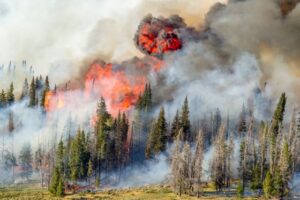
On-site hazards are less of a factor when calculating this score, and more of a consideration when determining minimum fire monitoring requirements. Colorado winds can reach up to 80 miles per hour, especially March through May. The average ember travels .5 to 1 mile but can travel more than 5 miles in high winds.
Wildfire risk is a combination of your:
- Environmental fire hazards: This includes nearby vegetation, slope of the land, and weather patterns, including wind, heat, and humidity.
- Exposure: How likely your building or business is to be impacted by wildfire.
- Mitigation: Fire safety upgrades including, ember-resistant vents, non-combustible roofing and siding, multi-pane tempered glass, and creating a brush perimeter/defensible space zone.
Read More:
- Understanding Colorado’s New Defensible Space Zones
- Spring and Summer Fire Hazards in Denver
- Office Conversion Fire Safety System Upgrades and Fire Watch Protocols
- Fire Watch Protocol Updates in Denver What Smoke Control Rational Analysis Means for Denver Builders
- EV Charging Station Fire Watch Protocols in Denver
How Your Wildfire Score Impacts Fire Watch Requirements?
Your score combined with your industry, building specs, and non-environmental fire hazards are calculated to determine your minimum fire watch requirements. Non-environmental hazards include on-site chemicals, flammable materials, and hazardous materials.
That said, if your score is 4 or 5, you’ll almost certainly require:
- A trained and certified fire watch professional versus an untrained and uncertified employee.
- Patrol frequency of every 15 to 30 minutes, versus every 15 to 60 minutes per circumstance.
- Extended post-hot work monitoring, lasting up to 4 hours, versus 30 to 60 minutes.
How Often Are Fire Risk Assessments Required?
As with all other risk factors, your insurance company will complete a comprehensive risk assessment annually before they renew your policy. For new businesses or policyholders, insurers have 15 days from the date of your application to provide your wildfire score. You have the right to appeal your score after completing mitigation improvements. Your insurance company will provide a new score within 30 to 60 days. When clearing brush for a new score, you’ll need to provide a Physical Inspection Report from a Certified Wildfire Mitigation Specialist.
Mid-Cycle Wildfire Resistance Upgrades
If you clear brush, upgrade to ember-resistant vents, or make other wildfire-mitigation upgrades before your next assessment, don’t forget to notify your insurer.
Compliant Fire Watch in Colorado Springs and The Mile High City
If your risk score has increased, or you require trained and certified fire monitoring for any reason—Scout Security has you covered. We understand that emergencies arise and are available for both pre-scheduled and 24/7 services.
Book now or add us to your emergency contact list.